




If you are shipping goods, knowing your incoterms is essential to understanding who is responsible for what in your supply chain.
Read on to learn all about incoterms and how to choose the right one for your shipment.
Incoterms in Plain English: The Incoterms Guide for Freight Shipping
What are Incoterms?
Freight incoterms (International Commercial Terms) are the standard terms used in sales contracts for importing and exporting. They are used to define responsibility and liability for goods over the course of a shipment. In other words, they spell out when responsibility for the goods transfers from the supplier to the buyer. They also define who pays which costs for the goods and their transport.
How Incoterms Impact Your Shipping Cost
You can use our freight rate calculator to help you decide how different incoterms will impact your freight cost. For example, when shipping EXW, you’ll be responsible for the added cost of getting your goods from your supplier to the seaport or airport. Simply choose container, box, or pallet shipping, enter your dimensions and weight, and you’ll get an instant estimate of freight shipping costs.
List of All 11 Incoterms
- EXW – Ex Works: The seller’s responsibility is to make the goods available for pickup at the warehouse or factory. From that point forward, the buyer assumes responsibility for all costs and risks. For most importers and exporters, this means working with a freight forwarder that arranges the entire shipment, starting at pickup from the factory.
- FCA – Free Carrier: The seller is responsible for delivering the goods to the carrier at a named place, which is usually the terminal or a warehouse. Once the goods are handed over to the carrier, the risk transfers to the buyer.
- CPT – Carriage Paid To: The seller is responsible for the costs of transporting the goods to a named destination. Responsibility transfers to the buyer once the goods are delivered to the agreed-upon destination.
- CIP – Carriage and Insurance Paid To: This incoterm is the same as CPT except that with CIP, the seller much also arrange and pay for insurance coverage in case of loss or damage to the goods during transit to the agreed-upon destination.
- DAP – Delivered at Place: The seller is responsible for arranging the entire shipment up to delivering the goods to a named place. Risk transfers to the buyer upon delivery. The seller is responsible for clearing goods for export but the buyer assumes responsibility for import customs duties, fees, and taxes.
- DPU – Delivered at Place Unloaded: The seller is responsible arranging the shipment and delivering the goods to a named place. They are also responsible for unloading them. Risk transfers to the buyer once the goods are unloaded.
- DDP – Delivered Duty Paid: The seller is responsible for entire shipment, including customs clearance and fees, and delivering the goods to the buyer’s premises. This incoterm places the maximum responsibility on the seller.
- FAS – Free Alongside Ship: The seller is responsible for picking up the goods at the factory, clearing them for export, and delivering them to a departure location, usually the ship loading dock. Tisk transfers to the buyer when the goods are placed alongside the ship; they are responsible for the main leg of transit and every other step in delivery.
- FOB – Free On Board: The seller is responsible for packaging, pickup, and delivery of goods onto a vessel at the port of shipment. Liability transfers to the buyer once the goods are on board the vessell; the buyer is responsible for every other step of the journey.
- CFR – Cost and Freight: The seller is responsible for transportation to the port of origin and for loading the goods onto the vessel. They are also responsible for transportation to the destination port – but they are not liable for that portion of the journey. Instead, risk transfers to the buyer when the goods are on boarded at the origin port.
- CIF – Cost, Insurance, and Freight: Similar to CFR, but the seller also arranges and pays for insurance coverage for the goods during transit to the port of destination.
2020 Incoterms
The 2020 Incoterms, updated from the 2010 Incoterms, are a set of international trade terms that define the responsibilities and obligations of buyers and sellers when shipping goods. They are designed to facilitate smooth and efficient international trade by providing standardized rules for the delivery of goods, payment, risk transfer, and other key aspects of international transactions.
2020 Incoterms Rules for Any Mode of Transport
Whatever mode of transport you use – sea, air, road, or rail – you’ll need to choose your incoterm. However, not every incoterm can be used for every mode.
The following seven incoterms can be used for both ocean and air shipping:
- EXW – Ex Works
- FCA – Free Carrier
- CPT – Carriage Paid To
- CIP – Carriage and Insurance Paid To
- DAP – Delivered at Place
- DPU – Delivered at Place Unloaded
- DDP – Delivered Duty Paid
2020 Incoterms for Sea and Inland Waterway Transport
These four incoterms can be used for sea and inland waterway shipments only:
- FAS – Free Alongside Ship
- FOB – Free On Board
- CFR – Cost and Freight
- CIF – Cost, Insurance, and Freight
2010 Incoterms
The International Chamber of Commerce (ICC) updates incoterms every ten years or so. Prior to 2020, the last update was in 2010. The 2010 version was largely similar to the 2020 version.
However, in 2020 some changes and clarifications were made to better reflect modern trade practices and technology.
Using 2010 Incoterms After 2020
It is generally advisable to use the most current set of Incoterms – that is, the 2020 Incoterms. These updated terms are designed to reflect modern trade practices and provide more clarity and specificity, which can help reduce misunderstandings and disputes in international trade.
However, it is not prohibited to use the 2010 Incoterms if both the buyer and seller agree to do so.
It’s essential to clearly specify in the sales contract which set of Incoterms is being used to avoid any confusion or disputes.
2020 Incoterms vs. 2010 Incoterms
Here are some differences between the 2020 Incoterms and the 2010 Incoterms:
- Introduction of DPU: In 2020, the DPU (Delivered at Place Unloaded) incoterm replaced DAT (Delivered at Terminal). DPU allows for delivery at a specific place, not just at a terminal, providing more flexibility.
- Insurance in CIP and CIF: The 2020 Incoterms clarify that in CIP (Carriage and Insurance Paid To) and CIF (Cost, Insurance, and Freight), the seller is responsible for obtaining insurance coverage with minimum coverage. In the 2010 Incoterms, this was not explicitly stated.
- Different Levels of Security Obligations: The 2020 Incoterms include more detailed security-related obligations, aimed at addressing increased security concerns in international trade.
- Bill of Lading with FCA: The 2020 Incoterms allow the use of the FCA term in conjunction with a bill of lading. In the 2010 Incoterms, FCA was typically associated with multimodal transport and not used with a bill of lading.
Incoterms for Air Freight
Incoterms commonly used for air shipments are:
EXW (Ex-works), in which the buyer assumes responsibility at the seller’s warehouse and takes care of everything including transportation and insurance.
CIP (Carriage and insurance) , which puts responsibility for insurance on the seller.
CPT (Carriage Paid To) , in which the seller delivers the goods and covers all fees involved in delivering the goods to the named destination. After delivery, the buyer assumes responsibility.
DDP (Delivered Duty Paid) , which puts most obligations on the seller. They carry all the costs and risks of transport, insurance, and customs clearance. This is the only incoterm that lists the seller as the importer of record at destination.
DAP-Delivered At Place , where the seller covers the costs involved in main carriage but is not responsible for customs clearance.
These Incoterms can be adapted for air freight transactions, ensuring that responsibilities and costs are clearly defined between the parties involved in the trade.
Why are Incoterms Important in 2025?
Importers and exporters should consider which incoterms is best for them before the contract of sale is negotiated. This can prevent surprise costs and unnecessary complications.
Choosing an incoterm means getting on the same page as your supplier – it aligns everyone on shipping procedures when multiple parties and stakeholders are involved. These globally accepted terms ensure the timely payment of goods, services, and duties, while protecting suppliers, carriers, and buyers.
Incoterms Chart and List
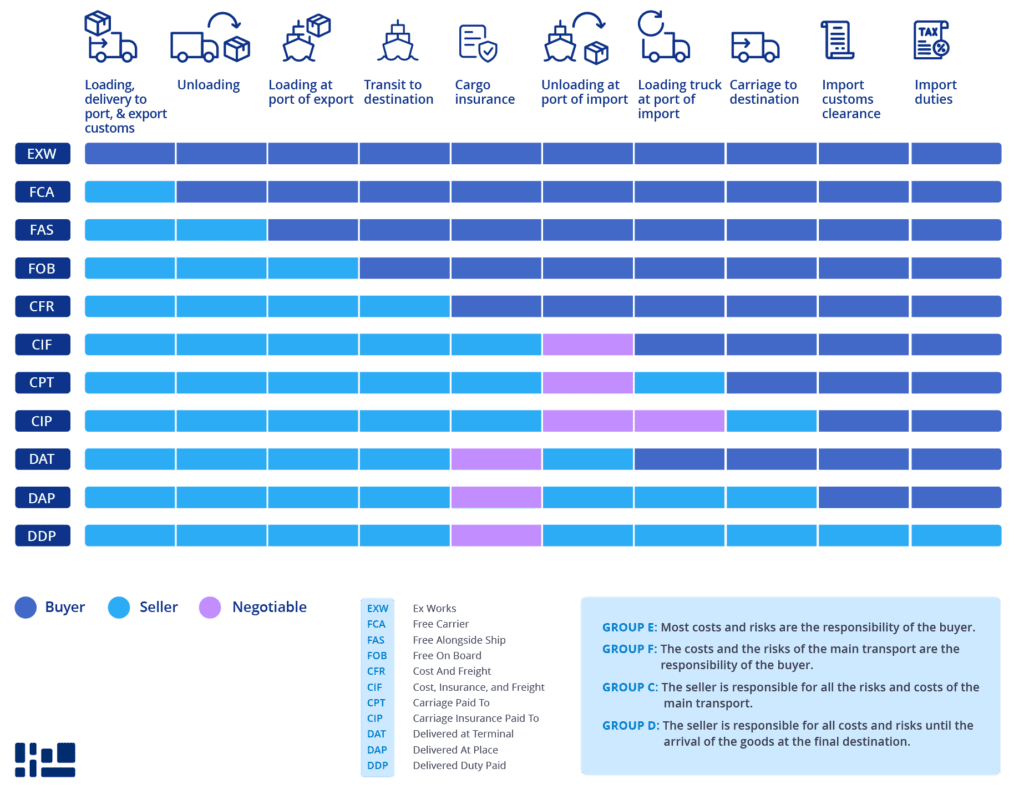
Check out this quick reference chart of Incoterms and the breakdown of whether the buyer or seller is responsible for what at various points in the international supply chain.
What Incoterms Should I Use?
Here are some of the most common incoterms and when you might choose them:
FOB (Free on Board)
This very common incoterm is for sea freight only, and means that liability and responsibility for cost transfer to the buyer when the goods are loaded “on board” the shipping vessel.
FOB gives the buyer a high degree of control over the freight shipping process. Since the buyer is choosing their own forwarder, they benefit from greater flexibility with regards to cost, terms, and shipping planning.
EXW (ExWorks)
The ExWorks incoterm means that responsibility transfers to the buyer at the supplier’s warehouse and not on board the vessel.
This means the buyer pays for and is responsible for goods’ transport every step of the way, from door to door. All the supplier needs to do is prepare the goods for pick up.
This incoterm gives the buyer full control over freight costs, but also means they are responsible for everything that happens in the origin country– which is frequently not their country of residence. More experienced shippers may benefit from using this incoterm.
FCA (Free Carrier)
When using FCA, the buyer assumes responsibility and costs once the goods are loaded onto a mode of transportation or delivered to a specific location agreed upon by the buyer and seller – typically this is a port.
This incoterm is used for all shipping modes.
With FCA, the supplier is responsible for packaging and transport at the origin. This means the supplier has more responsibility than they do with ExWorks, but the buyer still assumes costs and responsibilities earlier than they do when using FOB.
Main Differences Specific to a Country
The above advice covers most countries in most circumstances. But there are some factors to keep in mind when choosing an incoterm with your supplier:
- Customs procedures are much more relaxed at porous borders, like within the EU
- Different countries require different produres and paperwork for shipments: the US requires a Customs Bond, importing into the UK requires a Deferment Account, and exporting from India includes a withholding tax.
When to Challenge Advice
Some freight forwarders prefer only using a favored set of incoterms because they “seem to work.” Therefore don’t be surprised if some forwarders push back on your selection of incoterm, despite it being the most appropriate incoterm for your shipment.
What Shipping Incoterms Don’t Cover
Incoterms do not cover property rights, possible force majeure situations and breach of contract. Include of these within the contract of sale. Similarly, all incoterms except the C terms do not assign responsibility for arranging insurance. Cargo insurance is, therefore, a separate cost for buyers.
Define Named Place in the Sales Contract
When the incoterm is written in the sales contract, the named place should immediately follow the three letter incoterm abbreviation, e.g. “FCA Shenzen Yantian CFS.” Be precise when defining the location, especially with larger cities that may have several terminals, and with larger terminals that may have several drop-off points. You can use this global port finder to find specific port codes.
How Letters of Credit Limit Choice of Incoterm
If the sale is being completed with a letter of credit or documentary credit, the chain that releases funds begins with the seller providing several documents to the bank, including the bill of lading/air waybill. Letters of credit are used where there is limited trust between the seller and the buyer. That rules out EXW, because the supplier will be paid before pickup. F terms require trust because if the buyer cancels the international transit, the supplier won’t have a bill of lading to present to the bank. D terms require trust because the seller is bearing all of the transport costs. That leaves the four C terms as the best options to use with a letter of credit.